Industrial facilities face constant connectivity challenges from dust, vibration, and power fluctuations. Many standard routers fail in these conditions, causing expensive downtime for operations.
A quality 5G industrial modem router offers dual-SIM failover, rugged construction, and easy cloud management for consistent performance. These attributes prevent disruptions in mobile and remote industrial setups.
⚡ Quick Verdict
List of Best 5G Industrial Modem Routers
| Router | Main Advantage | Ethernet | SIM Support | Check Price |
|---|---|---|---|---|
| Teltonika RUTM54 | Global Telit modem, dual-band Wi-Fi | 5 × Gigabit | Dual SIM + eSIM | Check price on Amazon |
| D-Link 5G PoE+ Gateway* | PoE connectivity | Model dependent | Model dependent | Check price on Amazon |
| Teltonika RUTM20 | Compact size, global Telit modem | 2 × Gigabit | Dual SIM + eSIM | Check price on Amazon |
| LINOVISION Industrial 5G* | Industrial connectivity | Model dependent | Model dependent | Check price on Amazon |
| Teltonika RUTX50 | Dual-band Wi-Fi, automatic failover | 5 × Gigabit | Dual SIM | Check price on Amazon |
📋 How We Evaluated
Reviewers evaluated products based on rugged build quality for harsh conditions. Real performance under load and value for money were key metrics. Amazon rating signals and user reviews determined suitability for industrial environments.
Detailed Reviews
Teltonika RUTM54 5G Industrial Router – Global Telit Modem, 👑 Premium Pick
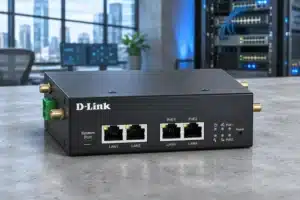
| 5 Gigabit Ethernet Ports | 1 WAN + 4 LAN |
| 5G Download Speed | 3.4 Gbps |
| eSIM Support | Up to 7 profiles |
| WiFi Standard | 802.11ac Wave 2 |
What We Found
The RUTM54 uses a global Telit modem for Sub-6 5G, listed at 3.4 Gbps down and 900 Mbps up. Two Mini SIM slots and an eSIM, up to seven profiles, can fail over automatically.
Five Gigabit ports cover one WAN and four LAN, and dual-band Wi-Fi is listed up to 867 Mbps. Built-in GNSS, geofencing, and RMS are the extras I would actually weigh.
💬 My Take
My read is that the Telit modem, eSIM, and GNSS make this the fuller industrial pick. I would choose it when tracking and remote admin sit next to raw 5G speed.
Who It’s For
I would shortlist this for field crews who need wired ports, Wi-Fi, and a location fix in one box. Construction and logistics sites fit, especially if RMS will handle remote admin. The eSIM profiles help when carrier changes should not mean a truck roll.
✅ Pros
- Global Telit modem ensures worldwide 5G coverage.
- Integrated GPS aids in precise tracking applications.
- Excellent failover with dual SIM and eSIM.
❌ Cons
- WiFi may not be as fast as WiFi 6 models.
- Requires careful eSIM profile management.
- Price point suits premium segments.
D-Link 5G/4G PoE+ Rugged Compact Modem/Gateway, Industrial B🏆 Editor’s Pick
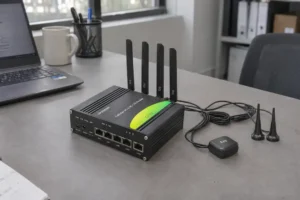
| 4 Gigabit Ethernet Ports | 4 |
| PoE+ with PD-Alive | 60W Budget |
| Dual SIM 5G | Failover Enabled |
| TAA/NDAA Compliance | Yes |
What We Found
The D-Link packs a compact rugged case for tight cabinets, vans, and rough sites. Integrated PoE+ with PD-Alive sends data and power, so you can skip a separate PoE switch. Dual-SIM 5G failover is aimed at first responders, transit, and industrial sites.
Four Gigabit Ethernet ports sit on the box, and D-ECS is listed for larger fleets. TAA and NDAA compliance, VPN support, and carrier certification are also called out.
💬 My Take
My read is that PoE+ plus dual-SIM failover is the real reason to pick this box. I would choose it when cabinet space is tight, and a camera or sensor needs power.
Who It’s For
I would shortlist this for mobile vans, kiosks, and small cabinets that need power over Ethernet. First responders and transit crews are the clearest fit when a second SIM has to take over. Camera installs also make sense, because one cable can carry power and data.
✅ Pros
- PoE+ integration eliminates extra hardware needs.
- Excellent dual SIM failover ensures uptime.
- Strong compliance with TAA and NDAA.
❌ Cons
- Price may exceed some budgets.
- Limited cloud features compared to competitors.
- Requires technical setup knowledge.
Teltonika RUTM20 Compact 5G Industrial Router – Global Telit💰 Best Value
| 5 Gigabit Ethernet Ports | 1 WAN + 4 LAN |
| 5G Speed | 3.4 Gbps DL |
| Active PoE | In and Out |
| eSIM Profiles | Up to 7 |
What We Found
The RUTM20 puts a global Telit 5G modem in a small body, with downloads listed up to 3.4 Gbps. Teltonika aims it at POS terminals, kiosks, and camera housings. Dual SIM plus an eSIM, up to seven profiles, can switch carriers without a site visit.
Active PoE in and out can power the router and one downstream device on one cable. Five Gigabit ports and dual-band Wi-Fi 5 with MU-MIMO, listed for 150 clients, round it out. 4G fallback is noted up to 1.6 Gbps.
💬 My Take
My read is that size, PoE passthrough, and eSIM failover are the reasons this exists. I would pick it when the enclosure is tiny and a truck roll is expensive.
Who It’s For
I would shortlist this for kiosks, point-of-sale, and camera spots with almost no spare room. PoE passthrough matters when an outlet is missing and a second device still needs power. Small sites that want eSIM failover without a large chassis should look here.
✅ Pros
- Active PoE simplifies power needs.
- Compact design fits tight spaces.
- Strong dual SIM failover.
❌ Cons
- May lack advanced security modules.
- WiFi performance not top tier.
- Requires setup for eSIM activation.
LINOVISION Industrial 5G Cellular Router – Verizon/AT&T/T-Mob🥈 Runner-Up
| 5 Gigabit Ethernet Ports | 1 WAN + 4 LAN |
| 5G Speed | 3.4Gbps DL / 900Mbps UL |
| Dual SIM Failover | Automatic signal/data usage |
| VPN Support | OpenVPN, IPsec, WireGuard |
What We Found
LINOVISION lists 5G SA and NSA with 4×4 MIMO, up to 3.4 Gbps down and 900 Mbps up. It also falls back to 4G LTE Cat 19 or 18. You get five Gigabit ports, with one WAN that can act as LAN, plus a DI, a DO, and USB-A.
Verizon, AT&T, and T-Mobile certification is stated, along with dual-SIM failover. Firewall, DDoS protection, and VPN options such as OpenVPN, IPsec, and WireGuard are named too.
💬 My Take
My read is that the port count and carrier certifications do more work than the headline speed. I would pick this when activation hassle is the bigger risk.
Who It’s For
I would look at this when a site needs several wired devices and a certified SIM path. Warehouses and plants that use digital inputs and outputs are a natural match. Fleet work can use it if you want carrier approval before rollout.
✅ Pros
- Five Gigabit Ethernet ports allow flexible device connections.
- Automatic failover maintains network uptime during outages.
- Certified compatibility simplifies carrier integration.
❌ Cons
- Cloud management requires additional subscription fees.
- GPS integration may not suit all non-location based uses.
- Setup complexity for advanced VPN features.
Teltonika RUTX50 Industrial 5G Router
| 5G Download Speed | 3.3 Gbps |
| 5G Modes | SA and NSA |
| WiFi | Dual Band MU-MIMO |
| Network Compatibility | 4G Cat 20, 3G |
What We Found
The RUTX50 is listed at 3.3 Gbps down, with standalone and non-standalone 5G. Dual SIM auto failover and WAN backup are the uptime story here. It also notes 4G LTE Cat 20 at up to 1.6 Gbps, plus dual-band Wi-Fi 5 with MU-MIMO.
I would treat it as a simpler 5G step-up, not a port-heavy gateway.
💬 My Take
My read is that failover and a clear speed rating carry this model. I would pick it for a plain industrial link, not when you need PoE or lots of ports.
Who It’s For
I would look at this for fleets and smaller sites that want 5G now and a 4G fallback. It fits teams that care more about SIM backup than extra I/O. If you only need a few clients on Wi-Fi, the MU-MIMO radio is enough to start.
✅ Pros
- Fast 3.3 Gbps download speeds available.
- Dual SIM auto failover provides backup.
- Backward compatible with 4G LTE.
❌ Cons
- Limited Ethernet ports compared to others.
- WiFi 5 may lag behind WiFi 6.
- Less detailed specs available.
What to Look For Before Buying
I would start with the cabinet, not the speed chart. Ask what fails first: heat, a dead SIM, or a remote config you cannot reach.
Check Rugged Build Quality
Check the case for tight enclosures, vehicle shock, and temperature swings, not just a metal look. If the sheet lists industrial build or extreme conditions, match that to your site. A tougher housing is what keeps a mobile install from becoming a repeat visit.
Value Connectivity Failover Options
Dual-SIM auto failover is the feature I would not skip on a remote cabinet. An eSIM with several profiles can change carriers without opening the box. Carrier certification, where it is listed, makes the first SIM activation less of a gamble.
Rating Performance and Speed Ratings
Match the stated 5G downlink to the job, whether that is video, telemetry, or a busy LAN. MIMO, SA or NSA support, and a 4G fallback speed tell you more than a single peak number. Wi-Fi ratings matter only if clients will not sit on Ethernet.
Verify VPN and Management Features
Look for named VPN types, such as WireGuard, OpenVPN, or IPsec, if the link leaves the site. Cloud or RMS tools matter when nobody can stand at the cabinet. DI and DO ports are worth it only if you need a hardware signal, not just routing.
Frequently Asked Questions
What makes a 5G industrial modem router different from consumer models?
Industrial units are built for cabinets, vehicles, and rough sites, not a desk. Failover, carrier options, and management tools are there to keep a link up. A home router rarely lists those duties.
How does dual SIM failover benefit industrial operations?
If the primary SIM drops, the router can move traffic to the second SIM or another WAN. That matters at sites where a person cannot swap a card the same day. It does not add speed. It cuts the gap when one path dies.
Which features should buyers check for value?
I would check port count, stated 5G and 4G rates, and whether PoE removes a power brick. VPN names and a remote management platform tell you the ongoing cost of ownership. Certifications help when the carrier must approve the hardware.
Do these routers support eSIM for flexibility?
Some of these Teltonika models list an integrated eSIM with up to seven profiles, besides two physical SIMs. That can change carriers remotely, so a tech does not have to visit. Not every router here advertises eSIM, so read that line before you assume it.
What is the role of GPS in these routers?
Where GNSS is listed, it can place the router or the vehicle on a map. Geofencing can flag when that asset leaves a set area. I would not assume GPS on a model that never names it.
🎯 Final Verdict
I would shortlist the D-Link when PoE+ and a small rugged case matter more than extra ports. LINOVISION is the one I would open next if you need five Ethernet ports and named US carrier certification.
The RUTM54 is my pick when GNSS, eSIM profiles, and RMS belong in the same box. Check the SIM and band fit with your carrier before you commit.